Let's visit Numberland
Research Studies and Results
Let's
visit Numberland
Research Studies and Results
Here you find more detailed information on the research on 'Let's visit Numberland' and links to download the full articles. Some additional articles provide a quick overview on the concept.
Background
“Let’s visit Numberland” has been scientifically evaluated twice with “kindergarten German type” children (In Germany the children attend kindergarten from the age of 3, until they enter school at the age of 6. The children go on five days a week, either only for the morning or for the entire day).
From 2003 to 2005, Dr. Gerhard Friedrich and school psychologist Horst Munz carried out two trials with 3 to 5+ year olds. The project war funded by the Ministry of education, cultural affairs, and sports of the German state of Baden-Württemberg as well as the Robert-Bosch-Foundation. In 2006, the results were published in a peer-reviewed journal.
From 2005 to 2009 Dr. Sabina Pauen, professor for developmental psychology at the University of Heidelberg, conducted another study with four to five year olds. Both studies involved many children with to some extent severe language problems.
The second study, since it ran over 5 years, also provided broad feedback from primary teachers on the 'Numberland children', many of them from underprivileged families. All teachers confirmed that the children were now much better prepared for year one: knowledge, self-esteem, language, overall motivation.
Findings
Within ten weeks only the Numberland children gained the mathematical competence and understanding they normally would have achieved within one year; the control group more or less remained the same.
The same was true for the linguistic competence, both passive and active, of the children.
The socio-economic background of the children was irrelevant for the gain of competence.
Both sexes benefit, the girls even a little bit more than the boys.
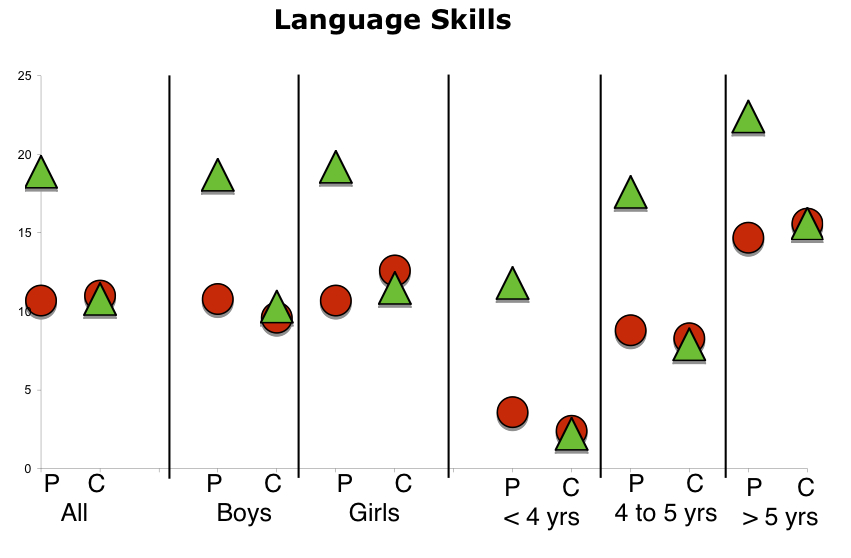
The age specific results show a striking development of the children regarding both math and language skills: Naturally the younger children had a much lower base level than the older (red dots). Yet the tasks were all taken from tests evaluating whether or not a child aged 5+ may enter school. So obviously the older children achieved much higher scores (green triangles). But after only 10 weeks of Numberland the under 4 year old children scored on average higher than the base level of the one year older! The same was true for the development of the 4 to 5 year olds compared to the base level of the over 5 year olds who again made significant progress.
The teachers felt motivated and competent to creatively apply Numberland.
The second study by Sabina Pauen with a similar test design included 4 to 5 year olds and confirmed the positive effects of “Let’s visit Numberland”. It additionally pointed out that the concept increased the confidence of the staff in teaching math and that they felt very comfortable with the concept.
Description of the study by Friedrich/Munz
During 10 weeks 46 children aged 3 to 5+ traveled to Numberland once a week. Each week they visited one number for approximately 50 to 60 minutes. Whenever suitable, the respective number of the week was picked up during the daily routine (circle time, creative play, sports, meals etc.). The children had access to the material for free play. In parallel, a control group of 46 comparable children carried on with their normal routine and had no access to Numberland. In a second run, this setting was repeated with underprivileged children, many of them having severe language problems and lacking other skills. The charts depict the results of that second run.
Project and control groups were tested before and after the 10 weeks in which the project took place. The tests comprised tasks such as conceiving and building sets of numbers, colors and shapes, remembering numbers, cognition of details, general reasoning powers. Regarding active and passive language skills, the children made a story out of some pictures, were asked what they remembered from a story that had been read out to them, and they had to carry out tasks of differing complexity. The effects of 'Let's visit Numberland' both on math relevant thinking and on language have been tested twice with significant results.
Literature
Further Publications
Gerhard Friedrich, Barbara Schindelhauer (2015). Let’s visit Numberland: A highly emotive and efficient reason for reasoning. In: Mathematical Association, Primary Mathematics, volume 19, issue 1, pp. 13-16. Mathematical Association, www.m-a.org Free download
Gerhard Friedrich, Barbara Schindelhauer (2014). Let’s visit Numberland: An Emotive, Story-based Contribution to Numeracy and Literacy Development. In: Jörg F. Maas, Simone C. Emig, Carolin Seelmann (eds.). Prepare for Life! Raising Awareness for Early Literacy Education. Results and Implications of the International Conference of Experts 2013. Stiftung Lesen 2014 (pp. 79-85) Free download (4,7MB)
NCETM National Centre for Excellence in the Teaching of Mathematics (2011). Focus on...Numberland. Early Years Magazine, Issue 25/2011 (online resource). www.ncetm.org.uk
Gerhard Friedrich, Viola de Galgóczy, Barbara Schindelhauer (2010). Let’s visit Numberland – playfully discover the world of numbers. Self-published handbook, ifvl Waldkirch. Also available in German, Polish, Estonian; other languages pending. Details
For more publications (in German) and articles on other subjects please refer to
www.ifvl.de/Publikationen.html